Different types of investments offer varying levels of risk and potential returns
Understanding Investment Types
Investments fall into three main categories: equity (ownership), fixed-income (lending), and cash equivalents. Each category contains various investment vehicles with different risk profiles, potential returns, and liquidity characteristics. Before diving into specific investment types, it’s important to understand some fundamental concepts:
What Makes a Good Investment?
A good investment aligns with your financial goals, risk tolerance, and time horizon. Key factors to consider include:
- Expected return on investment
- Risk level compared to potential reward
- Investment timeframe (short-term vs. long-term)
- Liquidity needs (how quickly you can access your money)
- Tax implications of different investment types
Why Diversification Matters
Diversification—spreading your investments across different asset classes—helps manage risk. When one investment underperforms, others might compensate for the loss. A well-diversified portfolio typically includes:
- Multiple asset classes (stocks, bonds, cash, etc.)
- Investments across different sectors and industries
- A mix of domestic and international investments
- Both growth-oriented and income-producing assets
Investment Risk Spectrum: From Safest to Riskiest
Different types of investments carry varying levels of risk. Generally, higher risk investments offer higher potential returns, while lower risk options provide more stability but lower growth potential. Understanding where each investment falls on the risk spectrum can help you build a balanced portfolio.
The investment risk spectrum: lower risk generally means lower potential returns
| Risk Level | Investment Types | Potential Return | Liquidity | Best For |
| Very Low | Savings accounts, CDs, Treasury bills | 1-3% | High to Medium | Emergency funds, short-term goals |
| Low | Government bonds, municipal bonds | 2-5% | Medium | Income, capital preservation |
| Medium | Corporate bonds, dividend stocks, REITs | 4-8% | Medium to High | Income with growth |
| High | Growth stocks, international stocks, ETFs | 7-12% | High | Long-term growth |
| Very High | Options, commodities, cryptocurrencies | 10%+ | Varies | Speculation, high risk tolerance |
Not Sure About Your Risk Tolerance?
Take our free risk assessment quiz to determine your investor profile and get personalized investment recommendations.
Low-Risk Investment Types
Low-risk investments are ideal for short-term goals, emergency funds, or conservative investors who prioritize capital preservation over growth. While these investments won’t generate substantial returns, they provide stability and security.
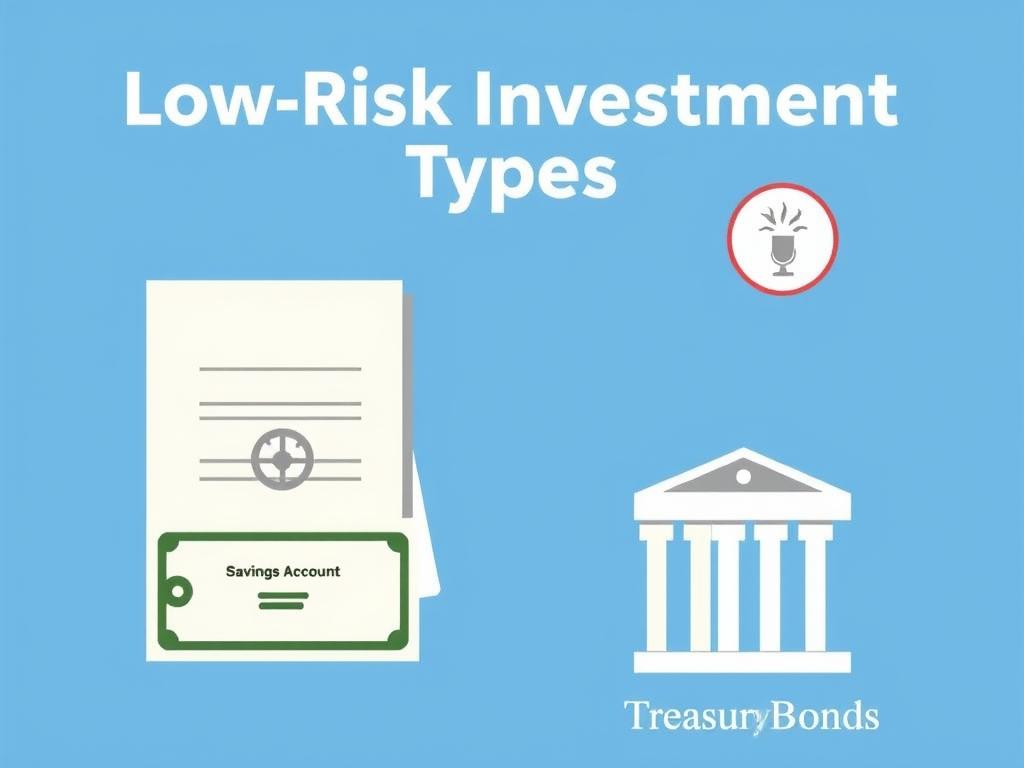
1. High-Yield Savings Accounts
High-yield savings accounts offer higher interest rates than traditional savings accounts while maintaining FDIC insurance protection (up to $250,000 per depositor, per bank).
Advantages
- Highly liquid with easy access to funds
- FDIC insured up to $250,000
- No risk of losing principal
- No minimum investment requirements with many banks
Disadvantages
- Returns typically don’t outpace inflation
- Interest rates can fluctuate
- Some accounts have minimum balance requirements
- May have monthly withdrawal limits
2. Certificates of Deposit (CDs)
CDs are time deposits offered by banks that pay a fixed interest rate for a specified term (typically 3 months to 5 years). The longer the term, the higher the interest rate typically offered.
Advantages
- Fixed, predictable returns
- FDIC insured up to $250,000
- Higher interest rates than savings accounts
- Various term options to match your timeframe
Disadvantages
- Early withdrawal penalties
- Funds are locked for the CD term
- Returns may not keep pace with inflation
- Interest rates are fixed even if market rates rise
3. Treasury Securities
Treasury securities are debt obligations issued by the U.S. government, including Treasury bills (T-bills), Treasury notes (T-notes), and Treasury bonds (T-bonds). They’re considered among the safest investments available.
Advantages
- Backed by the “full faith and credit” of the U.S. government
- Exempt from state and local taxes
- Various maturity options (from 4 weeks to 30 years)
- Highly liquid secondary market
Disadvantages
- Lower yields compared to corporate bonds
- Long-term bonds are subject to interest rate risk
- Returns may not outpace inflation
- Subject to federal income tax
Looking for Low-Risk Investment Options?
Compare current rates on high-yield savings accounts, CDs, and Treasury securities to find the best low-risk investment for your needs.
Medium-Risk Investment Types
Medium-risk investments offer a balance between growth potential and stability. These options are suitable for investors with a moderate risk tolerance and a medium to long-term investment horizon (typically 3-10 years).
1. Corporate Bonds
Corporate bonds are debt securities issued by companies to raise capital. When you buy a corporate bond, you’re essentially lending money to the company in exchange for regular interest payments and the return of principal at maturity.
Advantages
- Higher yields than government bonds
- Regular income through interest payments
- Less volatile than stocks
- Various credit qualities to choose from
Disadvantages
- Default risk (company may fail to repay)
- Interest rate risk (value decreases when rates rise)
- Less liquid than stocks
- Lower long-term returns than stocks historically
2. Dividend Stocks
Dividend stocks are shares in companies that distribute a portion of their earnings to shareholders regularly. These companies are typically well-established with stable cash flows.
Advantages
- Regular income through dividend payments
- Potential for capital appreciation
- Dividends may increase over time
- Lower volatility than growth stocks
Disadvantages
- Dividends can be reduced or eliminated
- Stock price can decline, offsetting dividend income
- Typically slower growth than non-dividend stocks
- Dividend income is taxable
3. Real Estate Investment Trusts (REITs)
REITs are companies that own, operate, or finance income-producing real estate across various sectors. They allow investors to add real estate to their portfolios without directly buying property.
Advantages
- High dividend yields (REITs must distribute 90% of taxable income)
- Real estate exposure without direct ownership
- Portfolio diversification
- Liquidity (publicly traded REITs)
Disadvantages
- Sensitive to interest rate changes
- Dividend income taxed as ordinary income
- Property-specific risks (vacancies, market downturns)
- Some REITs have high management fees
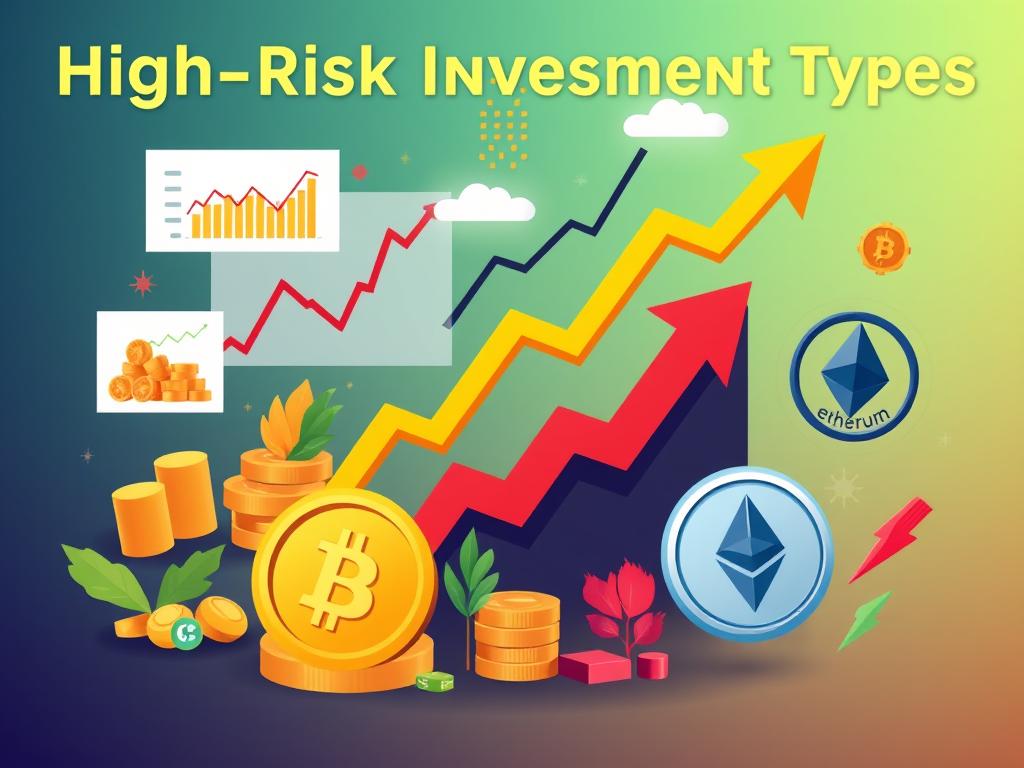
High-Risk Investment Types
High-risk investments offer the greatest potential for growth but come with increased volatility and the possibility of significant losses. These options are best suited for investors with a high risk tolerance, long-term investment horizon, and the financial capacity to withstand potential losses.
1. Growth Stocks
Growth stocks are shares in companies expected to grow at an above-average rate compared to other companies. These companies typically reinvest profits into the business rather than paying dividends, focusing on expansion and innovation.
Advantages
- Potential for significant capital appreciation
- Exposure to innovative companies and sectors
- Historically higher long-term returns than other investments
- High liquidity
Disadvantages
- High volatility and price swings
- No income through dividends
- Often trade at high valuations
- More vulnerable during market downturns
2. Commodities
Commodities are physical goods such as gold, silver, oil, agricultural products, and other raw materials. Investors can gain exposure to commodities through futures contracts, ETFs, or by investing in companies that produce these resources.
Advantages
- Portfolio diversification (often moves inversely to stocks)
- Hedge against inflation
- Tangible assets with intrinsic value
- Potential for high returns during supply shortages
Disadvantages
- High volatility due to supply/demand fluctuations
- No income generation (no dividends or interest)
- Storage costs for physical commodities
- Complex pricing influenced by global events
3. Cryptocurrencies
Cryptocurrencies are digital or virtual currencies that use cryptography for security and operate on decentralized networks based on blockchain technology. Bitcoin, Ethereum, and thousands of other cryptocurrencies offer alternative investment opportunities.
Advantages
- Potential for extraordinary returns
- 24/7 trading market
- Portfolio diversification
- Blockchain technology applications beyond currency
Disadvantages
- Extreme volatility and price swings
- Regulatory uncertainty
- Security concerns (hacking, lost keys)
- Limited practical applications currently
Ready to Explore Higher-Risk Investments?
Learn more about growth investing strategies and how to incorporate higher-risk assets into a balanced portfolio.
Stocks vs. Bonds: Key Differences
Stocks and bonds represent the two largest investment categories and form the foundation of most investment portfolios. Understanding their differences is essential for creating a balanced investment strategy.
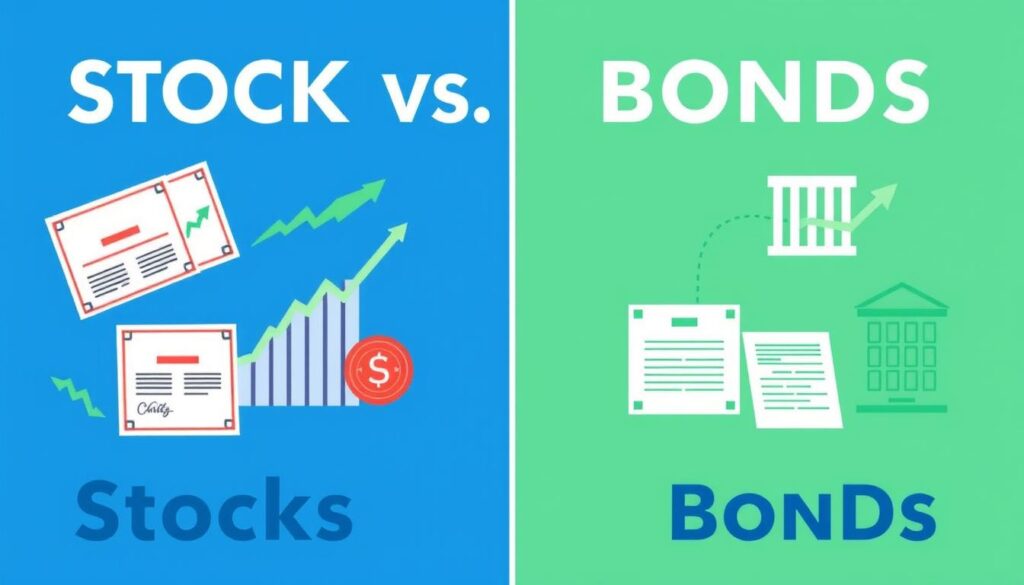
Stocks represent ownership while bonds represent loans
| Feature | Stocks | Bonds |
| What You Own | Partial ownership in a company | Debt issued by a company or government |
| Income | Potential dividends (not guaranteed) | Regular interest payments |
| Growth Potential | Typically higher | Typically lower |
| Risk Level | Higher | Lower |
| Volatility | Higher price fluctuations | More stable prices |
| Claim on Assets | Last claim (after bondholders) | Priority claim over stockholders |
| Voting Rights | Yes (common stocks) | No |
| Maturity Date | None | Yes (when principal is returned) |
ETFs vs. Mutual Funds: Which Is Right for You?
Exchange-Traded Funds (ETFs) and mutual funds are both popular investment vehicles that pool money from multiple investors to purchase a diversified portfolio of securities. While they share similarities, they have key differences in how they’re traded, managed, and taxed.
ETFs trade like stocks while mutual funds are priced once daily
| Feature | ETFs | Mutual Funds |
| Trading | Trade throughout the day like stocks | Priced and traded once daily after market close |
| Minimum Investment | Price of one share (can be fractional) | Often $1,000+ initial investment |
| Management Style | Mostly passive (index-tracking) | Both active and passive options |
| Expense Ratios | Typically lower (0.1%-0.5%) | Typically higher (0.5%-1.5%) |
| Tax Efficiency | More tax-efficient structure | Less tax-efficient, more capital gains distributions |
| Transparency | Holdings disclosed daily | Holdings disclosed quarterly |
| Automatic Investments | Not always available | Widely available |
Beginner Tip: ETFs are often recommended for beginners due to their lower investment minimums, lower fees, and ease of trading. However, mutual funds may be better for regular automatic investments, such as in a 401(k) plan.
Investment Types by Time Horizon
Your investment time horizon—the length of time you expect to hold an investment before needing the money—should significantly influence your investment choices. Different types of investments are better suited for different time horizons.
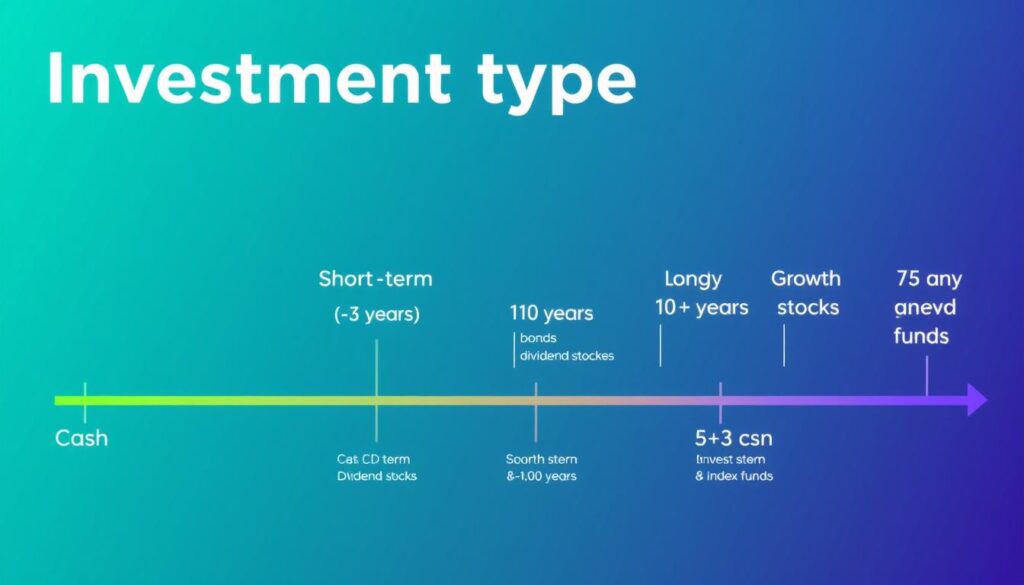
Matching investment types to your time horizon helps balance risk and return
Short-Term (0-3 Years)
For goals within the next three years, focus on capital preservation and liquidity rather than growth.
- High-yield savings accounts
- Money market accounts
- Short-term CDs
- Treasury bills
- Short-term bond funds
Medium-Term (3-10 Years)
For mid-range goals, balance growth potential with moderate risk.
- Corporate and municipal bonds
- Balanced mutual funds
- Dividend stocks
- REITs
- Index ETFs
Long-Term (10+ Years)
For distant goals like retirement, focus on growth and accept higher short-term volatility.
- Growth stocks
- Small-cap stocks
- International stocks
- Sector-specific ETFs
- Real estate investments
Create Your Personalized Investment Plan
Get a customized investment strategy based on your goals, time horizon, and risk tolerance.
Passive Income Investment Types
Passive income investments generate regular income with minimal ongoing effort after the initial investment. These investment types are popular for creating income streams during retirement or supplementing employment income.

Dividend Stocks
Companies that distribute a portion of their earnings to shareholders regularly.
- Typical yield: 2-5% annually
- Payments usually quarterly
- Potential for dividend growth over time
- Additional potential for capital appreciation
Bonds & Fixed Income
Debt securities that pay regular interest payments until maturity.
- Typical yield: 2-8% depending on risk
- Predictable income schedule
- Various options (government, municipal, corporate)
- Lower volatility than stocks
Real Estate Investments
Property investments that generate rental income or REITs that pay dividends.
- Typical yield: 3-10% annually
- Potential tax advantages
- Appreciation potential
- Hedge against inflation
Passive Income Tip: Creating a “passive income ladder” with investments that pay at different times throughout the year (monthly, quarterly) can help establish a more consistent income stream.
Investment Roadmap for Beginners
If you’re new to investing, the variety of investment types can seem overwhelming. This step-by-step roadmap will help you build a solid foundation before advancing to more complex investments.
Start with the basics and gradually expand your investment knowledge
-
Build an Emergency Fund
Before investing, establish an emergency fund covering 3-6 months of expenses in a high-yield savings account. This provides financial security and prevents having to sell investments during market downturns.
-
Maximize Retirement Accounts
Take advantage of tax-advantaged retirement accounts like 401(k)s (especially if your employer offers matching contributions) and IRAs. These accounts provide tax benefits that boost your long-term returns.
-
Start with Index Funds or ETFs
Begin investing with broadly diversified, low-cost index funds or ETFs that track major market indices like the S&P 500. These provide instant diversification across hundreds of companies with a single investment.
-
Add Individual Bonds or Bond Funds
Incorporate bonds or bond funds to reduce portfolio volatility. The percentage allocated to bonds typically increases as you approach your investment goals or retirement.
-
Consider Individual Stocks
Once comfortable with funds, you might explore individual stocks. Start with established companies you understand and gradually expand your stock portfolio as your knowledge grows.
-
Explore Alternative Investments
As your portfolio and knowledge grow, consider adding alternative investments like REITs, commodities, or international stocks for additional diversification.
Start Your Investment Journey Today
Open an account with a trusted online broker and begin building your investment portfolio with as little as $100.
Investment Return Calculator
Use this calculator to estimate potential returns from different types of investments based on your initial investment, monthly contributions, expected rate of return, and time horizon.

Note: This calculator provides estimates based on a constant rate of return. Actual investment returns will vary over time and may be positive or negative. Past performance is not indicative of future results.
Getting Started with Investments
Understanding the different types of investments is the first step toward building a successful investment portfolio. Remember these key principles as you begin your investment journey:

- Start early: The power of compound returns means time is your greatest advantage.
- Diversify: Spread your investments across different asset classes to manage risk.
- Invest regularly: Consistent investing through market ups and downs (dollar-cost averaging) can reduce the impact of market volatility.
- Keep costs low: Investment fees can significantly impact long-term returns.
- Match investments to goals: Align your investment choices with your time horizon and risk tolerance.
- Stay informed but avoid overreacting: Market fluctuations are normal; focus on your long-term plan.
Ready to Build Your Investment Portfolio?
Speak with a financial advisor who can help you create a personalized investment strategy based on your unique goals and circumstances.
Frequently Asked Questions About Investment Types
What investment type is best for beginners?
For beginners, low-cost index funds or ETFs are often recommended as they provide instant diversification, low fees, and don’t require extensive investment knowledge. Starting with a broad market index fund like an S&P 500 ETF gives exposure to hundreds of companies in a single investment.
How much money do I need to start investing?
You can start investing with as little as $1 with many online brokers that offer fractional shares. For mutual funds, minimum investments typically range from $500-$3,000, though some have no minimums. The most important thing is to start early, even with small amounts.
What’s the difference between saving and investing?
Saving typically involves putting money in safe, liquid accounts like savings accounts with minimal risk and low returns. Investing involves putting money into assets with the potential for higher returns but also higher risk. Saving is for short-term goals and emergencies, while investing is for longer-term goals like retirement.